
Traveling by Plane.
Duration: 50 minutes.
“I’m going to stay at a hotel.”
Knowing how to talk about travel plans helps you communicate clearly at airports, hotels, and with friends or coworkers. In this lesson, you will practice using the present continuous to talk about future plans, such as “I’m flying to New York next week” or “I’m going to stay at a hotel.”
Warm-Up Questions.
- Which airport have you used before?
- Do you prefer window seats or aisle seats? Why?
- What is one thing you always pack in your luggage?
- Do you enjoy airports? Why or why not?
- Where would you like to fly next?
Talking about holidays 🌊☀️⛱️ Real Easy English – BBC.
Listen to Neil and Georgie talk about the places they want to travel to in easy English.
Discussion Questions:
- What is Neil’s dream destination, and why does he want to go there?
- What is Georga’s dream destination, and what attracts her to it?
- What does Georga like to do when she is on holiday?
- What advice does Neil give about travelling to Japan?
- What does the word “staycation” mean? Can you give an example?
- Have you ever been on a staycation? How was your experience?
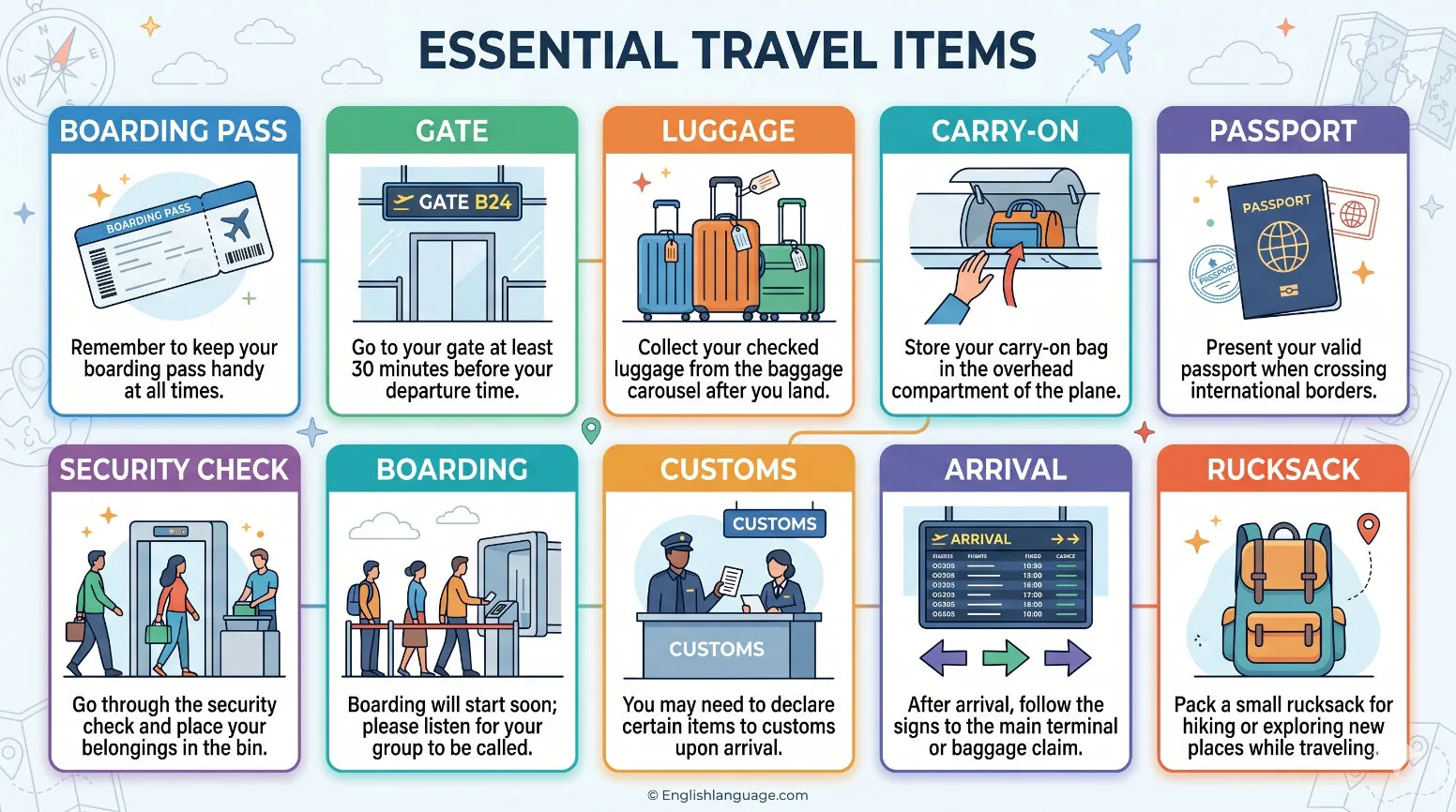
| Word / Phrase | Meaning | Example Sentence |
| boarding pass | paper or digital ticket to enter the plane | Show your boarding pass at the gate. |
| gate | area where you wait and enter the airplane | Our flight leaves from gate 12. |
| luggage | bags or suitcases for travel | I always check my luggage. |
| carry-on | small bag you take into the plane | My carry-on has my laptop. |
| passport | official travel document | I need my passport for international travel. |
| security check | place where bags are scanned | We go through security before boarding. |
| delay | when a flight is late | The flight has a 2-hour delay. |
| boarding | process of getting on the plane | Boarding starts at 6 p.m. |
| customs | airport area that checks goods and documents | We went through customs after landing. |
| arrival | when you reach your destination | Our arrival time is 9:30 a.m. |
Reading Text:
Paragraph 1 – Traveling by plane can be exciting.
Traveling by plane can be exciting, but it also requires planning. Most trips start at home, where you pack your luggage, check your flight schedule, and prepare documents like a passport or ID. Many travelers arrive at the airport two or three hours before their flight. This gives them enough time to check in, drop off luggage, and go through the security check.
Resumo: Paragrafo 1
Viajar de avião é emocionante, mas precisa de organização. O processo tem três etapas principais:
- Em Casa (At Home): Você arruma as malas (pack your luggage), confere o horário do voo e prepara os documentos (passaporte ou identidade).
- No Aeroporto (At the Airport): É importante chegar cedo, geralmente 2 ou 3 horas antes do voo.
- Procedimentos: Esse tempo é necessário para:
- Fazer o Check-in.
- Despachar as malas (Drop off luggage).
- Passar pela segurança (Security check).
Key Vocabulary
- Luggage / Baggage: Malas de viagem.
- Flight schedule: O horário/cronograma do voo.
- Passport / ID: Passaporte ou documento de identidade.
- Drop off: Deixar ou entregar algo (neste caso, as malas no balcão).
- Security check: Inspeção de segurança (onde passamos pelo raio-x).
💡 Teacher’s Tip
Pessoas confundem “Check-in” com “Security check”.
- Check-in: É quando você confirma sua presença e recebe o bilhete.
- Security check: É quando você e sua bagagem de mão passam pelo detector de metais.
Reading Text:
Paragraph 2 – After security, passengers look for their gate.
After security, passengers look for their gate. Airports usually have signs and screens that show the gate number and boarding time. Sometimes flights are delayed because of weather, maintenance, or traffic. When this happens, airlines make announcements and update screens with new information.
Resumo: Paragrafo 2
Depois de passar pela segurança, o passageiro precisa encontrar o local onde o avião está:
- Localização: Os passageiros procuram o portão (gate). Para isso, usam as placas (signs) e as telas (screens) que mostram o número do portão e o horário de embarque (boarding time).
- Atrasos (Delays): Às vezes, o voo pode atrasar por causa do tempo (clima), manutenção ou muito tráfego aéreo.
- Informação: Quando há mudanças, a companhia aérea faz anúncios de voz ou atualiza as telas.
Key Vocabulary
- Gate: Portão de embarque.
- Boarding time: Horário de embarque (quando você entra no avião).
- Delayed: Atrasado.
- Weather: Clima/tempo (ex: chuva, tempestade).
- Announcements: Avisos ou anúncios feitos pelo sistema de som.
💡 Teacher’s Tip
A diferença entre “Departure time” (horário de partida do avião) e “Boarding time” (horário que ele precisa estar no portão para entrar). Isso evita que ele perca o voo!
Reading Text:
Paragraph 3 – At the gate, boarding begins in groups.
A gate agent checks your boarding pass and ID. Then you walk through the tunnel and enter the plane. When you find your seat, you store your carry-on bag in the overhead compartment. Flight attendants give safety instructions and answer questions.
Resumo: Paragrafo 3
Este texto explica o que acontece desde o portão até você se sentar no avião:
- O Processo: O embarque (boarding) é feito em grupos. Um funcionário (gate agent) confere o seu bilhete e documento.
- Entrando no Avião: Você passa pelo túnel, entra no avião e procura o seu assento (seat).
- Bagagem de Mão: Você deve guardar sua mala de mão (carry-on bag) no compartimento acima da sua cabeça (overhead compartment).
- Segurança: Os comissários de bordo (flight attendants) dão as instruções de segurança antes da decolagem.
Key Vocabulary
- Boarding pass: Cartão de embarque (o seu bilhete).
- Seat: Assento/lugar.
- Carry-on bag: Mala de mão (aquela que vai com você dentro do avião).
- Overhead compartment: O bagageiro (espaço acima dos assentos).
- Flight attendants: Comissários(as) de bordo / Aeromoças.
💡 Teacher’s Tip
A palavra “Boarding” vem de “to board”, que significa “subir a bordo”. É importante o aluno saber que o “Boarding pass” é o documento mais importante nessa etapa.
Reading Text:
Paragraph 4 – During the flight, passengers relax, read, watch movies, or sleep.
Some flights offer snacks and drinks. On international flights, passengers often fill out a customs form. When the plane lands, people wait for the “arrival” signal before getting off. After leaving the plane, passengers go to the baggage claim area to pick up their luggage.
Resumo: Paragrafo 4
Este texto descreve o que os passageiros fazem no ar e como saem do aeroporto:
- Durante o Voo: Os passageiros relaxam, assistem a filmes ou dormem. Em voos internacionais, é comum preencher o formulário de alfândega (customs form).
- O Pouso: Quando o avião pousa (lands), todos devem esperar o sinal de autorização para sair.
- Retirada de Malas: Após sair do avião, os passageiros vão para a área de restituição de bagagem (baggage claim) para pegar suas malas.
Key Vocabulary
- To land: Pousar.
- Customs form: Formulário de alfândega (para declarar o que você está trazendo).
- Baggage claim: Área de restituição de bagagem (onde as malas giram na esteira).
- To pick up: Pegar ou buscar algo.
- International flights: Voos internacionais.
💡 Teacher’s Tip
Explique que “Baggage claim” é o nome oficial do lugar, mas muitos turistas perguntam apenas: “Where is my luggage?” ou “Where are the bags?”.
Grammar Focus Activity.
Complete the sentences using the present continuous for future plans:
(use: I’m / We’re / They’re + verb + -ing)
- ___ flying to São Paulo next week.
- ___ staying at a hotel near the airport.
- ___ meeting our friends for dinner tonight.
- ___ leaving for the airport at 5 a.m.
- ___ taking only a carry-on bag.
- ___ visiting our family for the holiday.
Wrap-Up Discussion.
Please answer these questions and send your responses to me on WhatsApp.
- What is your dream destination and why?
- What travel vocabulary did you learn today?
- What plans do you have for future travel?
Lessons selected for you.